
 +99871 200 32 00
 info@tangroup.uz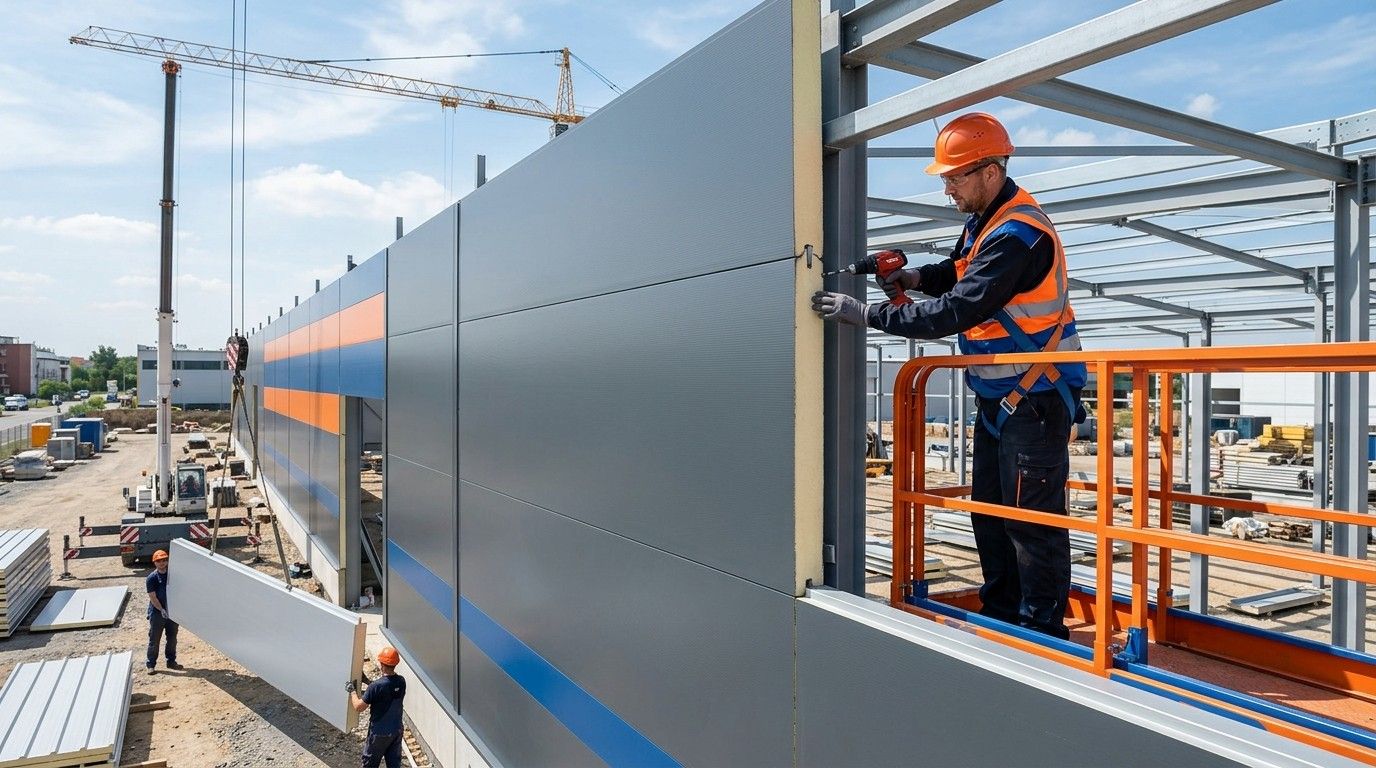
Modern construction demands speed, cost-efficiency, and high performance. When building industrial facilities, warehouses, shopping centers, or residential structures, traditional materials are increasingly being replaced by advanced solutions. Among these, sandwich panels stand out for their versatility and efficiency.
This material consists of three layers: a core insulation material sandwiched between two protective metal sheets. Below, we examine three key advantages of sandwich panels that simplify construction and reduce overall project costs.
1. Exceptional Thermal and Acoustic Insulation
One of the primary benefits of sandwich panels is their outstanding thermal performance. The inner core (typically mineral wool, polyurethane foam, or polystyrene) acts as a highly effective barrier against temperature transfer, keeping interiors warm in winter and cool in summer.
This insulation capability directly translates into energy savings. By reducing heat loss and gain, building owners can significantly lower their heating and cooling utility bills. Additionally, sandwich panels offer reliable acoustic insulation, which is crucial for reducing external noise in busy or industrial areas.
2. Rapid Installation and Lightweight Design
Unlike traditional brick or concrete, working with sandwich panels is remarkably fast and straightforward. They are prefabricated to specific dimensions and delivered to the construction site ready for assembly on a pre-built frame.
Key benefits of this rapid installation include:
- Construction timelines are shortened by weeks or even months.
- Reduced reliance on heavy machinery and long-term labor costs.
- The lightweight nature of the panels decreases the load on the foundation, allowing for more economical foundation designs.
- Assembly can be carried out in almost any weather condition, preventing seasonal delays.
3. Durability and Weather Resistance
The outer layers of sandwich panels are made of galvanized steel coated with protective polymers. This shielding ensures the panels remain highly resistant to corrosion, UV rays, and extreme weather conditions.
The materials do not rot, warp, or support mold growth, ensuring a lifespan that spans decades with minimal maintenance. Furthermore, panels utilizing fire-rated cores, such as mineral wool, offer excellent fire resistance, enhancing the overall safety of the structure.
In conclusion, sandwich panels represent a smart choice for modern projects where budget, time, and building efficiency are top priorities. They allow developers to deliver robust structures quickly while ensuring long-term operational savings.