
 +99871 200 32 00
 info@tangroup.uz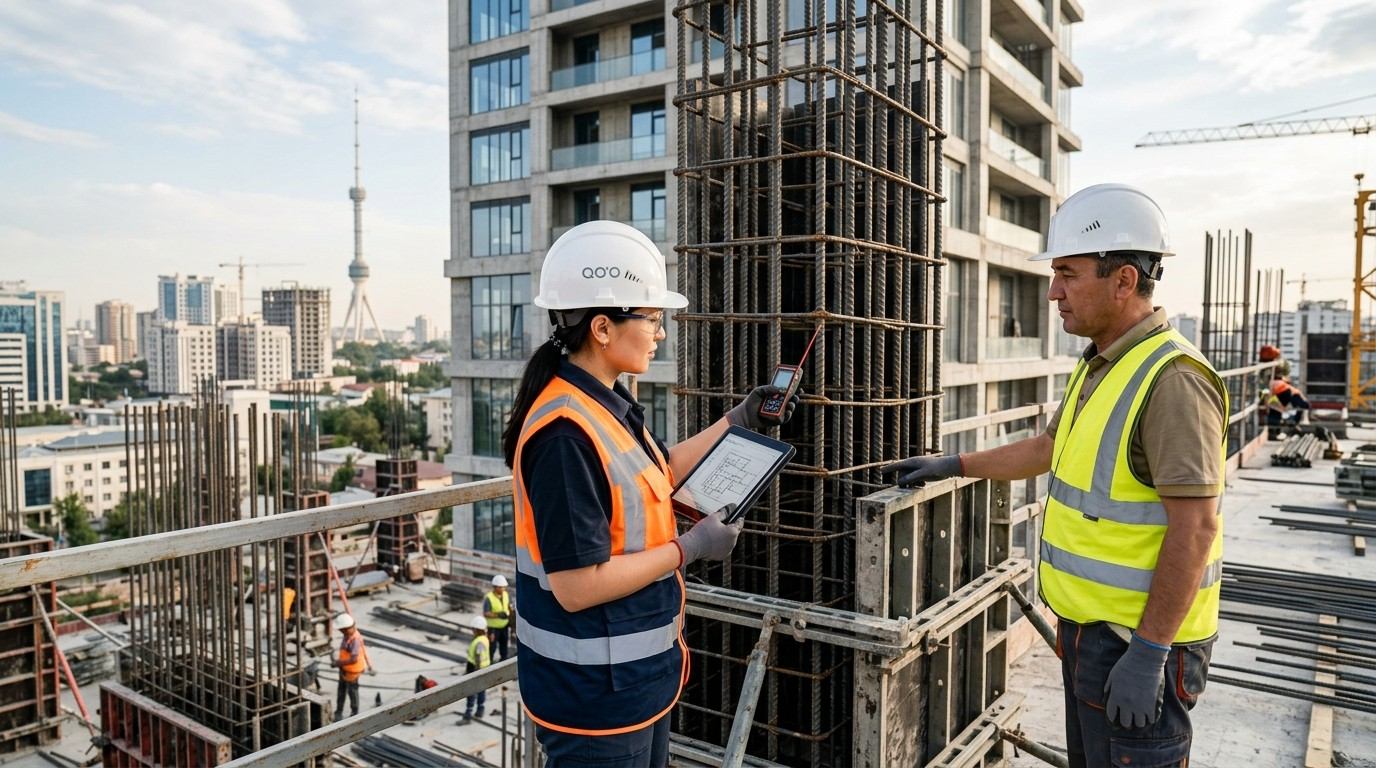
In the construction industry, quality is not just about the aesthetic appearance of a building; it is the core guarantee of its safety, durability, and long-term performance. In modern construction, quality control is a multi-stage system that begins at the design phase and continues until the building is officially commissioned. Below, we examine how this process is organized and what control methods are used today.
Control at the Design and Preparation Stage
Quality control begins long before the first cubic meter of concrete is poured on-site. At the initial stage, project and estimate documentation is thoroughly checked for compliance with current building codes and standards.
The design undergoes expert review, where engineering calculations, structural load capacities, and safety measures are re-analyzed. An error made at this stage can be extremely costly or even impossible to fix later. Therefore, a flawless design is the foundation of high-quality construction.
Incoming Inspection of Construction Materials
Every material delivered to the construction site—whether cement, rebar, brick, concrete mix, or small fasteners—undergoes strict inspection. This process is known as incoming control.
- Certificates of conformity and technical data sheets are verified.
- Visual inspections are conducted to detect cracks, rust, or deformations.
- Specialized laboratories test material samples, such as checking concrete for compressive strength.
Materials that fail to meet specifications are immediately rejected and barred from use. This ensures the structural integrity of the entire building.
Operational Control of Construction Works
Every construction process (such as foundation pouring, wall erection, or roofing) is monitored directly during execution. This is carried out by site foremen, engineers, and technical supervision specialists.
During operational control, compliance with technological guidelines and design specifications is verified. For instance, during bricklaying, the thickness of joints, alignment of rows, and mortar quality are constantly measured. Geodetic instruments are used to monitor any deviation of the building from vertical and horizontal axes.
Inspection of Hidden Works
In construction, there are certain works that become invisible once subsequent stages are completed. These include foundation reinforcement, waterproofing, and electrical wiring or piping inside walls.
These are classified as "hidden works" and must be formally accepted through dedicated inspection reports (acts of hidden works). Moving to the next stage is permitted only after these documents are signed. If hidden works are left unmonitored, identifying and fixing future issues becomes incredibly difficult and expensive.
Technical Supervision and Laboratory Testing
The role of independent technical supervision (construction supervision) is paramount in modern construction. Technical supervision specialists act on behalf of the client, objectively assessing work quality at every step.
They employ instrumental control methods, such as ultrasonic testing of welds, sclerometer testing of concrete strength, and thermal imaging to detect heat loss. This advanced testing reveals internal defects that are invisible to the eye.
Final Acceptance and Commissioning
Once all construction and installation works are complete, the final acceptance stage begins. At this point, all engineering systems—heating, ventilation, water supply, and electrical grids—undergo comprehensive testing.
A state commission reviews the completed building to ensure it complies with environmental, fire, and construction safety regulations. Only after all tests are successfully passed and final documents are signed is the building officially commissioned.
Quality control is an ongoing, systematic process that protects investments and ensures human safety. Paying attention to every detail during construction reduces future operational costs and significantly extends the lifespan of the building.